What the “4-Minute Rule” Means for Stroke
🧠 What the “4-Minute Rule” Means for Stroke
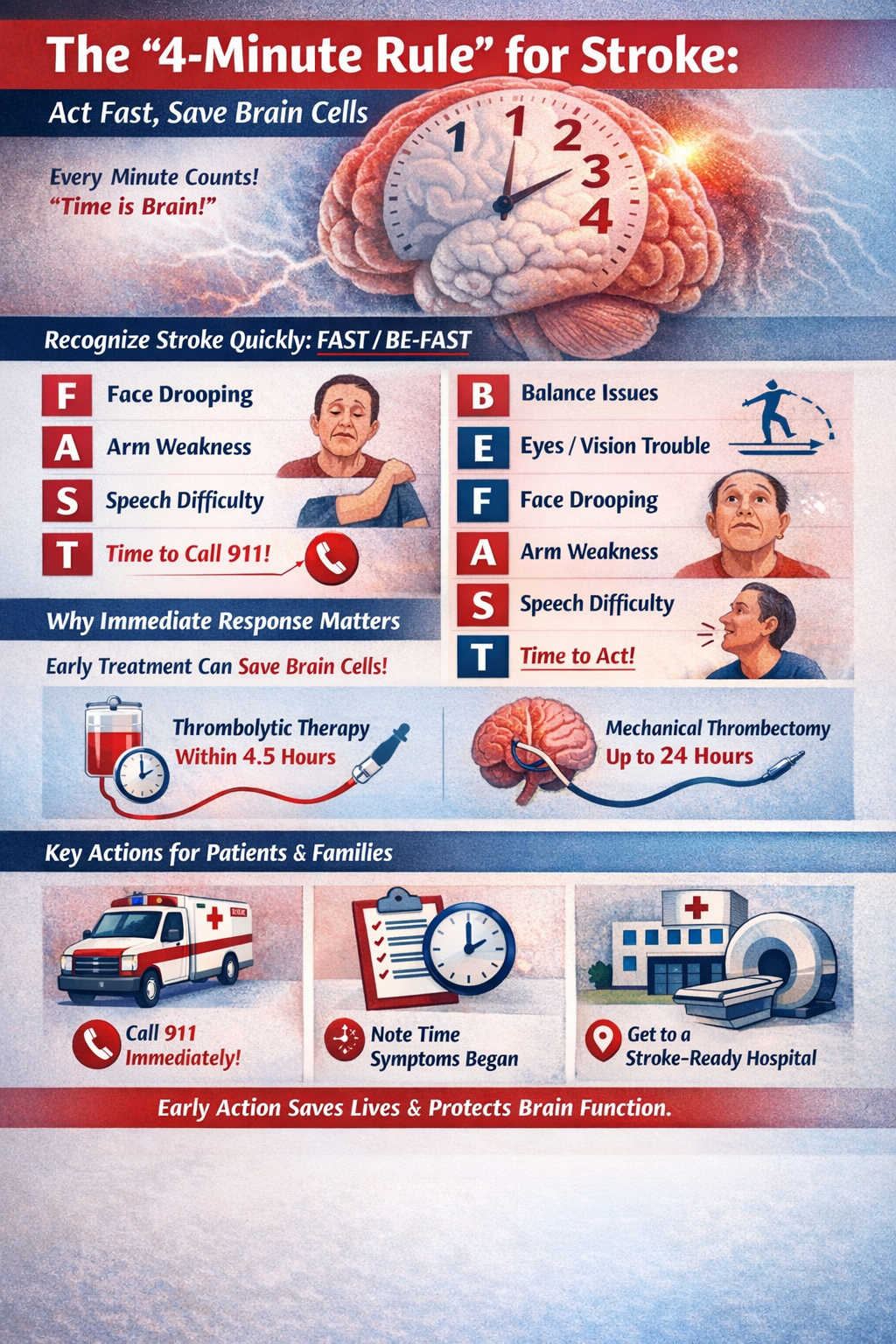
- Experts emphasize that in the event of a suspected stroke, people should act immediately — ideally within the first 4 minutes of symptom onset. This swift recognition and response strategy aims to trigger urgent medical assessment and rapid transfer to a facility capable of acute stroke care.
- The idea reflects the broader principle that every minute counts in stroke (“time is brain”), because millions of neurons are lost with each passing minute without treatment.
🩺 Recognizing Stroke Early — FAST/BE-FAST
Clinicians teach easy-to-remember acronyms to identify stroke symptoms quickly so that emergency services can be activated without delay:
FAST:
- Face drooping
- Arm weakness
- Speech difficulty
- Time to call emergency medical services immediately
Some clinicians also use BE-FAST to include balance and vision changes:
- Balance difficulty
- Eyes/vision trouble
- Face droop
- Arm weakness
- Speech difficulty
- Time to act
⏱ Why Immediate Response Matters
- In acute ischemic stroke, thrombolytic therapy (e.g., alteplase) is most effective when given as early as possible, with current evidence showing benefit when initiated within up to 4.5 hours from symptom onset — and the earlier the better.
- Mechanical thrombectomy for appropriate large-vessel occlusions may be performed up to 24 hours in selected cases based on imaging, but timely arrival still improves eligibility and outcomes.
- Delays in evaluation reduce the number of treatment options and increase risk of permanent disability or death.
🧑⚕️ Practical Takeaways for Patients and Caregivers
- Call emergency services immediately if stroke symptoms are suspected — do not wait for symptoms to fully evolve or assume they will resolve spontaneously.
- Note the exact time symptoms began, as this guides eligibility for time-sensitive therapies.
- Go to a stroke-ready hospital with CT/MRI and capacity for reperfusion therapies.
- Inform emergency dispatch of suspected stroke so pre-arrival notification can prompt rapid triage and imaging on arrival.
Summary: The “4-minute rule” is a public-health emphasis on speedy recognition and urgent action in suspected stroke — anchored in the clinical reality that earlier intervention saves brain tissue, reduces disability, and improves survival.